
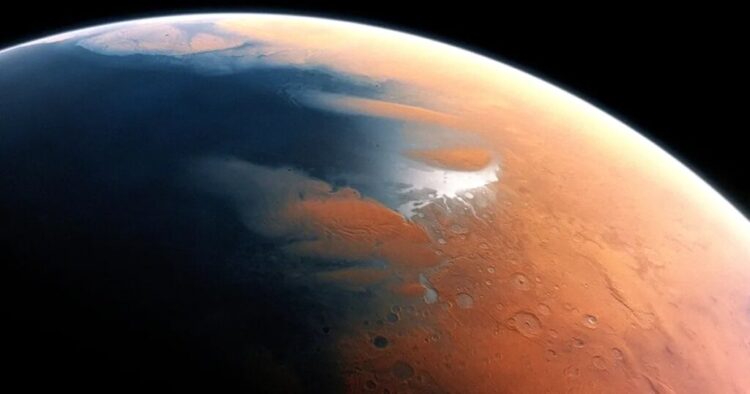
Scientists have identified compelling evidence of a vast ancient ocean on Mars that may have rivaled Earth’s Arctic Ocean in size. An international research team analyzed satellite data from the Coprates Chasma region within Valles Marineris, the solar system’s largest canyon, discovering geological structures that closely resemble river deltas on Earth. The findings, published in NPJ Space Exploration, suggest Mars was once a “blue planet” teeming with water roughly three billion years ago.
The researchers used high-resolution imagery from the European Space Agency’s ExoMars Trace Gas Orbiter and Mars Express orbiter, along with NASA’s Mars Reconnaissance Orbiter, to map the Martian landscape. “When measuring and mapping the Martian images, I was able to recognize mountains and valleys that resemble a mountainous landscape on Earth,” said coauthor Ignatius Argadestya, a University of Bern PhD student. “However, I was particularly impressed by the deltas that I discovered at the edge of one of the mountains.”
The team identified fan deltas—formations created when sediment from mountain streams empties into standing water—that mapped remarkably well onto similar structures on Earth. “The structures that we were able to identify in the images are clearly the mouth of a river into an ocean,” explained coauthor Fritz Schlunegger, a University of Bern geology professor. By analyzing these delta formations, researchers inferred an ancient sea level corresponding to the period of greatest surface water availability on Mars.
While previous studies have suggested the existence of Martian oceans, this research provides what scientists describe as the clearest evidence to date. “With our study, we were able to provide evidence for the deepest and largest former ocean on Mars to date—an ocean that stretched across the northern hemisphere of the planet,” Argadestya said. The discovery offers new insights into Mars’s potentially habitable past, though implications for ancient life remain uncertain.
NEWS NOW: