
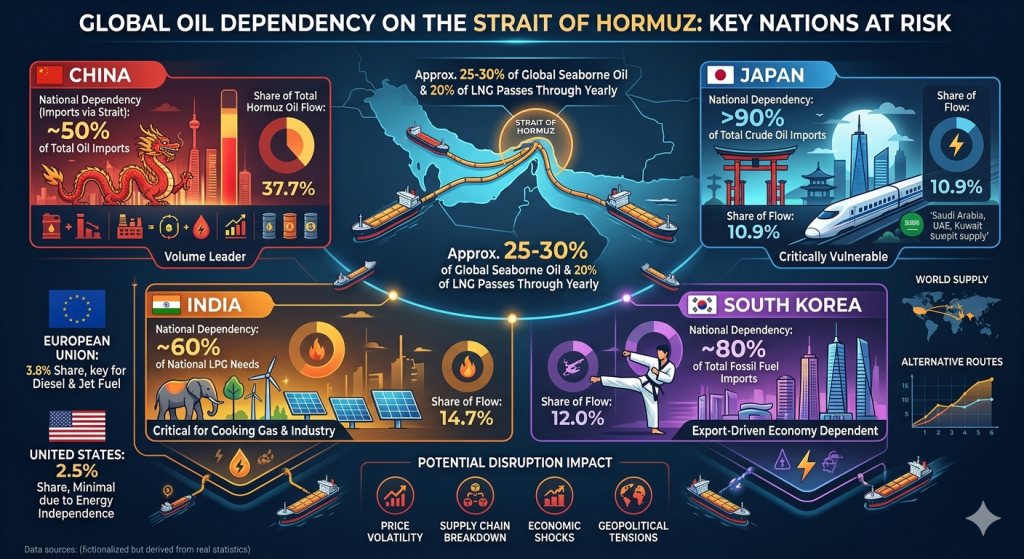
With 25 to 30 percent of the world’s seaborne oil transiting the Strait of Hormuz daily, any disruption to the 21-mile waterway would trigger an immediate energy crisis across Asia and send shockwaves through global markets.
STRAIT OF HORMUZ CRISIS COULD CRIPPLE GLOBAL ENERGY SUPPLY, ANALYSTS WARN
Japan, China, South Korea and India identified as most vulnerable nations
The Strait of Hormuz, a narrow 21-mile waterway separating Iran and Oman at the mouth of the Persian Gulf, remains the single most critical oil chokepoint on Earth — and growing tensions in the region have renewed fears about what a sustained blockade would mean for the global economy.
As of 2026, approximately 25 to 30 percent of the world’s seaborne oil and roughly 20 percent of global liquefied natural gas passes through the strait daily. The overwhelming majority of that flow is destined for Asia, making the region’s largest economies acutely exposed to any disruption.
Japan: The Most Physically Vulnerable
Japan faces the gravest national risk of any country should the strait be closed or disrupted. More than 90 percent of Japan’s total crude oil imports originate from Middle Eastern suppliers — Saudi Arabia, the United Arab Emirates, and Kuwait — all of which depend on Hormuz for export access.
The country accounts for 10.9 percent of total oil flows through the strait. With virtually no domestic energy reserves and limited alternative supply routes, any prolonged blockade would rapidly threaten Japan’s industrial output and public energy supply.
China: The Volume Leader
China is the single largest buyer of oil transiting the Strait of Hormuz, accounting for 37.7 percent of total flows. Approximately half of China’s total maritime oil imports pass through the waterway.
While Beijing has moved in recent years to diversify its energy supply through Russian pipeline agreements, analysts note that a closure of the strait would still paralyse nearly half of China’s seaborne energy imports — a scale of disruption with severe consequences for the world’s second-largest economy.
India and South Korea: Critical Exposure
India, which accounts for 14.7 percent of Hormuz oil flows, faces a particular vulnerability in its domestic LPG supply. Roughly 90 percent of the country’s imported liquefied petroleum gas — used primarily for household cooking — still transits the strait, despite efforts to diversify procurement through Russian routes.
South Korea, responsible for 12 percent of flows, is similarly exposed. Its heavily industrialised economy relies on fossil fuel imports for over 80 percent of its total energy needs, with the vast majority sourced from Persian Gulf producers.
Europe and the United States
The European Union, accounting for 3.8 percent of Hormuz flows, would face indirect but significant consequences, particularly in diesel and jet fuel markets, where the bloc sources approximately 20 percent and 50 percent of its supply respectively through the strait.
The United States, at 2.5 percent of flows, remains the least exposed among major economies. Years of domestic shale oil expansion have made Washington largely energy independent, though American markets would not be insulated from global price shocks triggered by a closure.
Countries Most Dependent on the Strait of Hormuz
| Country | Share of Hormuz Oil Flow | National Dependency |
|---|---|---|
| China | 37.7% | ~50% of total oil imports |
| India | 14.7% | ~60% of national LPG needs |
| South Korea | 12.0% | ~80% of total fossil fuel imports |
| Japan | 10.9% | >90% of total crude oil imports |
| European Union | 3.8% | ~20% of diesel; ~50% of jet fuel |
| United States | 2.5% | Minimal |
Strategic Implications
Energy analysts warn that the strait’s status as a global chokepoint gives Iran significant strategic leverage in any confrontation with Western powers or regional rivals. A deliberate blockade, even a temporary one, would trigger immediate oil price spikes, supply shortfalls across Asia, and cascading economic consequences worldwide.
With Iran’s missile capabilities now demonstrated to extend beyond previously assumed ranges, the vulnerability of strait-dependent nations has taken on renewed urgency in diplomatic and defence planning circles.
For Japan, South Korea, India, and China, the message is unambiguous: the world’s most important 21 miles of water is also its most dangerous.
NEWS NOW: