
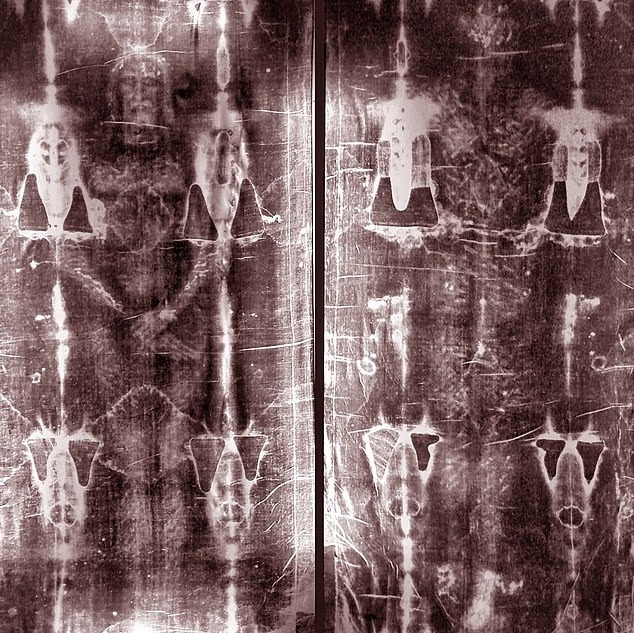
Researchers investigating the Shroud of Turin found that replicating its unique body image would require a burst of ultraviolet energy far exceeding the capabilities of modern technology, leading some to suggest the relic was created by an extraordinary event.
Italian physicist Paolo Di Lazzaro and his team at the ENEA Research Centre have reportedly identified scientific anomalies in the Shroud of Turin that some scholars suggest point toward the biblical resurrection of Jesus. After five years of experimentation using intense ultraviolet lasers to alter the chemical structure of linen fibers, researchers successfully replicated the shroud’s unique surface-level yellowing, yet determined that recreating a full-scale, life-sized image remains beyond the reach of modern technology.
Biblical scholar Jeremiah Johnston highlighted the staggering energy requirements calculated by the team, stating, “Paolo told me it would take 34,000 billion watts of energy traveling in one 40th of a billionth of a second to change the chemical makeup of a fine linen shroud to leave that image,” adding that according to Di Lazzaro, “We don’t have that power on Earth.” While the findings mirror the shroud’s microscopic characteristics such as the lack of pigments or dyes and the extremely shallow depth of the image scientists caution that the results are not yet definitive proof of the cloth’s origin, despite Johnston’s assertion that the image was likely created by a singular, high-power “nuclear event.”
NEWS NOW: