
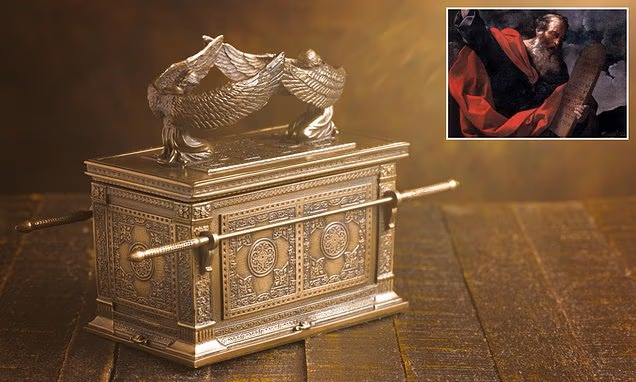
An Egyptologist has proposed a new theory suggesting that the Ark of the Covenant was not simply a sacred container for the Ten Commandments but a deliberate theological statement shaped by ancient Egyptian religious symbolism. David Falk, who holds a PhD in Egyptology from the University of Liverpool, argued that the Ark was modeled on Egyptian shrine furniture traditionally used to house statues of deities, but was intentionally designed without an idol.
According to Falk, ancient Egyptian sacred chests were often adorned with protective imagery such as uraeus cobras and winged goddesses, symbols believed to sanctify holy space and signify divine presence. He suggested that the Ark adopted this familiar visual language while subverting its meaning, emphasizing that God’s presence did not require a physical representation.
Falk argued that the sacred space of the Ark was not inside the chest itself, but above it, between the wings of the cherubim on the mercy seat. He noted that this design mirrors Egyptian throne imagery, where divine authority was symbolized through protective wings, but reinterprets it to reject idol worship. “The Ark was constructed using a visual language that everyone knew 3,300 years ago, but is mostly lost to us today,” Falk wrote.
The theory suggests the Israelites, after generations spent in Egypt, did not abandon Egyptian religious imagery entirely but intentionally reworked it. Falk said this approach turned familiar symbols into a theological rebuke, asserting the superiority of the Israelite God, whose presence was not confined to a statue.
The Ark of the Covenant, described in the Book of Exodus as a gold-covered acacia wood chest with carrying poles, was housed in the Tabernacle following the Exodus, traditionally dated by some scholars to around 1445 BC. While its ultimate fate remains unknown, disappearing from the biblical record before the Babylonian sack of Jerusalem in 586 BC, Falk’s theory reframes the Ark as a powerful symbol of religious identity and resistance rather than a conventional sacred object.