
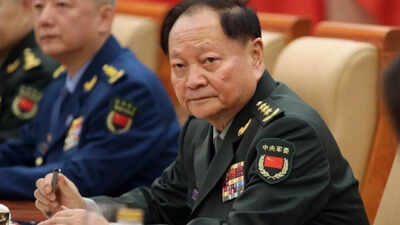
Chinese President Xi Jinping is purging top military generals, including his closest ally Zhang Youxia, in an unprecedented anti-corruption crackdown that prioritizes absolute loyalty over all else, leaving him virtually alone atop China’s military command structure while raising questions about the PLA’s readiness and stability.
Chinese leader Xi Jinping has launched what analysts are calling a seismic purge of the People’s Liberation Army, placing the country’s top-ranking general under investigation in a move that leaves Xi virtually alone atop the military hierarchy.
The decision to investigate Zhang Youxia, a battle-tested commander and longtime Xi ally whose ties to the Chinese leader stretch back a generation, signals that no one in China’s power structure is immune from the leader’s anti-corruption campaign—not even those considered untouchable.
The implications are profound. With China’s military leadership in disarray and questions swirling about Beijing’s readiness for potential conflict over Taiwan, Xi’s purge reveals a leader prioritizing loyalty above all else, even at the cost of short-term stability and institutional knowledge within the world’s largest armed forces.
An Unassailable Ally Falls
Zhang Youxia was no ordinary general. A fellow “princeling” whose father fought alongside Xi’s in China’s Civil War, Zhang had long been viewed as Xi’s closest military confidant. The 75-year-old combat veteran had been retained past normal retirement age, a clear sign of Xi’s trust. Yet on Saturday, China’s defense ministry announced in a terse 30-second video that Zhang and Liu Zhenli, who heads PLA joint operations, were under investigation for “suspected serious violations of discipline and law.”
The allegations are staggering. According to the Wall Street Journal, Zhang stands accused of leaking “core technical data on China’s nuclear weapons to the US” as well as accepting bribes for official acts “including the promotion of an officer to defense minister.” While CNN has not independently verified these claims, the official language used leaves little doubt about the severity of the charges.
An editorial in the People’s Liberation Army Daily accused Zhang and Liu of “seriously trampling on and undermining the system of ultimate responsibility resting with the Central Military Commission chairman”—coded language suggesting they threatened what matters most to Xi: his absolute authority over the military.
Jonathan Czin, a fellow at the Brookings Institution’s China Center and former CIA analyst, described Zhang’s downfall as “almost Shakespearean.” He explained that Xi’s anti-corruption campaign has evolved from targeting corrupt enemies to those he appointed himself, and now to individuals with whom he shares decades-long relationships. “For Xi to get rid of a guy like this is really remarkable,” Czin said, noting that in China’s vicious political system, such relationships “don’t take years to build, they take decades, or in this instance, potentially a lifetime.”
A Decade-Long Campaign Reaches Its Crescendo
The probe against Zhang represents the apparent culmination of Xi’s ruthless, more than decade-long effort to remake the military according to his vision. Since coming to power in 2012, Xi has overseen a sweeping transformation of the PLA, combining massive reorganization and technological modernization with an aggressive anti-corruption drive. More than 20 senior military officials have been placed under investigation or ousted since 2023 alone.
The latest moves have left the powerful Central Military Commission, which Xi chairs, virtually stripped of its uniformed leadership. Of the six uniformed members appointed at the 2022 leadership reshuffle, only one remains standing: Zhang Shengmin, the military’s anti-corruption czar. This leaves the PLA leadership “in a state of disarray right now,” according to Neil Thomas at the Asia Society Policy Institute’s Center for China Analysis.
Yet experts argue this purge demonstrates Xi’s strength rather than weakness. James Char, an assistant professor at Singapore’s S. Rajaratnam School of International Studies, notes that “the fact that Xi Jinping has been able to cashier so many PLA elites since he assumed power… is a clear sign his position in the regime is unassailable.”
Xi’s drive to control the military stems from his shrewd reading of history. He has studied how autocratic regimes fall when leaders lose control of their armed forces—a fate he is determined to avoid. The Chinese military is controlled by the Communist Party, not the state, making loyalty to the party’s leader paramount. As Thomas observed, the official language could suggest “Zhang was becoming too powerful for Xi’s liking,” or “simply that he betrayed [Xi’s] trust by helping corrupt the procurement bureaucracy.”
Corruption or Power Struggle?
The circumstances surrounding Zhang’s investigation remain murky, likely not only to outside observers but also within China’s famously opaque military establishment. Rumors have proliferated in the information vacuum, ranging from speculation about Xi losing his grip on power—a theory experts largely reject—to questions about whether Xi is crushing rival factions within the military.
Some analysts wonder whether allegations of sharing secrets represent legitimate concerns or merely the party’s effort to justify the purge to its own ranks. What seems clear is that Xi concluded, as Czin put it, that “the rot is so deep in the PLA and the mismanagement is so gross at the top that he needs to clean house within an entire generation of leaders.”
The purge has “reached a crescendo now where it’s hit the uppermost echelons of the party,” Czin said, demonstrating that “nobody in that system is safe, truly.” This represents “a potentially seismic shift in Chinese politics under Xi, and how he governs.”
Implications for Taiwan and Beyond
Perhaps the most urgent question concerns what this turmoil means for Beijing’s broader ambitions, particularly regarding Taiwan. China’s ruling Communist Party claims the self-ruled island as its own territory and has not ruled out using force to bring it under Beijing’s control. With Liu Zhenli—who coordinates the PLA’s top combat command institution—also under investigation, concerns arise about the military’s immediate operability, the morale of rank-and-file troops, and any timelines Beijing may have for achieving its Taiwan goals.
However, Czin suggests Xi may have calculated that now is a “safe time to clean house.” With a U.S. administration that doesn’t seem “particularly interested” in Taiwan and potential political changes in Taipei’s 2028 elections, Xi may feel he has breathing room to restructure his military leadership without immediate consequences.
James Char argues that despite these high-level purges, China’s military operations continue normally. “The PLA’s daily operations have carried on as normal despite these purges since a younger—and perhaps more professional—officer corps is on hand to assume those responsibilities,” he said. Xi has already been tapping second-line PLA officers to informally fill roles vacated by their disgraced predecessors.
Char maintains that “China’s military modernisers will continue to push for the two goals Xi has set for the PLA—namely, 2035 to basically complete its modernisation and 2049 to become a world-class armed forces.”
A Military Transformed—But at What Cost?
Xi’s vision for the PLA extends beyond mere modernization. He seeks a military that will defend the party—and its leader—above all else. This goal shapes everything from organizational structure to personnel decisions. The anti-corruption drive, while addressing genuine problems of graft and mismanagement, serves the larger purpose of ensuring absolute loyalty.
The scale of the purge is unprecedented. As Guardian reporting notes, of the seven men appointed to the Central Military Commission at the 2022 party congress, only two remain untouched: Xi himself and Zhang Shengmin, the anti-graft officer. The co-vice chair, He Weidong, was expelled from the party and PLA in October for corruption. Eight top generals were expelled on graft charges in October 2025, and two former defense ministers have been purged in recent years.
This crackdown has practical consequences beyond leadership instability. It is slowing procurement of advanced weaponry and affecting revenues of China’s biggest defense firms—potentially impacting the very modernization Xi champions.
Trust, Power, and the Future of Chinese Military Leadership
The Zhang Youxia case illustrates the brutal calculus of power in Xi’s China. Zhang’s revolutionary pedigree, combat experience, and decades-long relationship with Xi proved insufficient protection once the leader determined his authority might be threatened. The general who fought in Vietnam in 1979 and emerged as an avowed military modernizer ultimately fell victim to the system he helped build.
Foreign diplomats and security analysts watch these developments closely, understanding their significance for regional stability and global security. Lyle Goldstein, director of the Asia programme at Defense Priorities, notes the purge “raises larger issues about political stability in a rising, nuclear superpower” and “could be seen by many as reflecting poor judgment about some of [Xi’s] prior appointments.”
As Xi consolidates control over China’s military, he has made one thing abundantly clear: loyalty to him personally trumps experience, expertise, connections, and past service. Whether this ruthless approach ultimately strengthens or weakens China’s military capabilities remains to be seen. What is certain is that Xi Jinping now stands nearly alone at the pinnacle of the world’s largest armed forces—exactly where he wants to be.
The question that haunts observers is whether a military purged of its most senior, experienced leaders and rebuilt on the foundation of personal loyalty can achieve Xi’s ambitious goals. Only time will tell if this gamble pays off, but for now, the message echoes through every level of China’s military hierarchy: in Xi’s PLA, no one is truly safe, and absolute loyalty is the only currency that matters.
NEWS NOW: