
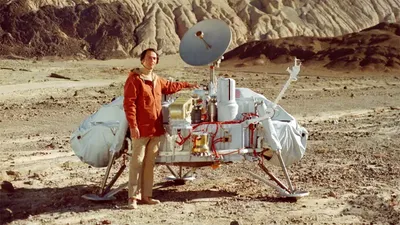
A provocative new study claims the 1976 Viking missions discovered Martian microbes but accidentally killed them by over-hydrating soil samples, sparking a call to rethink our search for extraterrestrial life.
Nearly 50 years after NASA’s Viking landers touched down on Mars, a new study suggests they may have detected microbial life that was inadvertently destroyed during testing. The researchers argue that the lander’s “Labelled Release” experiment produced positive biological signals that were incorrectly dismissed as chemical anomalies. According to the team, the introduction of liquid water likely “drowned” microbes adapted to hyper-arid conditions.
The team’s proposed “BARSOOM” model describes Martian microbes as semi-dormant autotrophs that store oxygen for metabolism. This hypothesis explains why the soil initially released radioactive gas when “fed” nutrients but failed to respond to subsequent injections. Co-author Dirk Schulze-Makuch noted, “The minute that that inner shift happens… they always die,” comparing the event to torrential rains killing desert bacteria on Earth.
While the scientific community has long attributed the Viking data to soil perchlorates, this new paper suggests those chemicals actually prove the presence of indigenous organics. The researchers warn that as human missions approach, understanding these potential life forms is urgent to prevent contamination. “Thus, future Mars exploration must have this back-and-forth, and this should begin today,” the paper concludes, urging a paradigm shift in astrobiology.
NEWS NOW: