
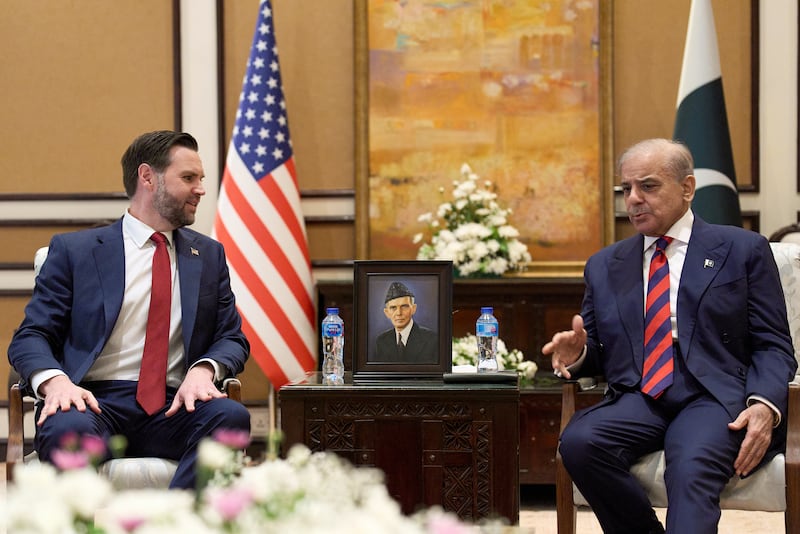
VIA NY TIMES:
Vice President JD Vance said on Sunday that 21 hours of peace talks in Pakistan, between the United States and Iran had failed to produce an agreement to end the war, leaving the question of what happens after the current two-week cease-fire up in the air.
“They have chosen not to accept our terms,” Mr. Vance said in a brief news conference in Islamabad, though he left open the possibility that terms could still be reached. “We leave here with a very simple proposal: a method of understanding that is our final and best offer,” he added. “We’ll see if the Iranians accept it.”
The marathon talks between high-level officials stretched past 6 a.m. local time on Sunday, a momentous encounter between decades-old adversaries as they sought to broker peace after more than a month of war. Mediated by Pakistan, the negotiating session was the highest-level face-to-face encounter between U.S. and Iranian officials since Iran’s 1979 Islamic Revolution, which put the two countries on a collision course.
Esmaeil Baqaei, the spokesman for Iran’s foreign ministry, said on social media earlier on Sunday that the discussions in Pakistan “were held on various dimensions of the main negotiation topics, including the Strait of Hormuz, the nuclear issue, war reparations, lifting of sanctions and the complete end to the war against Iran and in the region.” Mr. Baqaei, who was in Pakistan as part of the Iranian delegation, added that the success of the talks depended on the United States’ “acceptance of Iran’s legitimate rights and interests.”
Israel was not involved in the talks, and even though its forces have not struck Iran since the cease-fire was reached, they have continued to strike targets in Lebanon. On Saturday, Prime Minister Benjamin Netanyahu said that while Iran’s military had been badly damaged, the war was “not over.”
As Mr. Vance was detailing the impasse in negotiations, President Trump and Secretary of State Marco Rubio were at a sports arena in Miami for UFC 327, watching a video montage of past fights. Earlier in the evening, from Washington, Mr. Trump had projected nonchalance, claiming it did not matter to him whether the U.S. delegation reached an agreement with Iran. “We win, regardless,” he said. “We’ve defeated them militarily.”
Even though the talks did not produce a diplomatic breakthrough, the fact that the speaker of Iran’s Parliament, who was leading Iran’s delegation, met with the American vice president is still extraordinary, given the long history of animosity between the two nations. Just six weeks ago American and Israeli airstrikes killed Iran’s supreme leader, and Iranian officials pledged to avenge his blood.
On Tuesday, the United States and Iran agreed to a provisional cease-fire on Tuesday that suspended the fighting for at least two weeks. But in public statements since then, officials from the two governments have been far apart on several issues, including control of the Strait of Hormuz, what will happen to Iran’s nuclear stockpiles and whether the current cease-fire covers the fighting in Lebanon.
Israel’s military campaign in Lebanon against Hezbollah, the Iran-backed militant group, has threatened to derail the truce. Iran had accused Israel of breaking the cease-fire by continuing to attack in Lebanon, leading Mr. Trump to ask Israel to rein in its assault.
Israeli fighter jets have not attacked the Lebanese capital of Beirut since Wednesday. But Israel has kept up its airstrikes in southern Lebanon, including on Saturday morning, according to Lebanon’s state media.
Here’s what else we’re covering:
- Negotiating team: Mr. Vance was joined in Islamabad by Mr. Trump’s special envoy, Steve Witkoff, and son-in-law, Jared Kushner. The Iranian delegation, which includes Foreign Minister Abbas Araghchi and Mohammad Bagher Ghalibaf, the speaker of Iran’s Parliament, arrived earlier in the Pakistani capital. Read more about them here.
- Strait of Hormuz: The Defense Department said on Saturday that two U.S. warships crossed the Strait of Hormuz to begin an operation to clear mines from the critical waterway. Iran denied the claim. Only a handful of ships have passed through the strait since the cease-fire began this week. U.S. officials said one reason Iran had been unable to get more ships through was that it could not locate and remove all of the mines it laid in the waterway.
- Israel and Lebanon: The countries’ ambassadors to the United States are expected to meet in Washington next week for direct talks, but a settlement to end the war in Lebanon is not expected imminently. More than a million people — roughly a fifth of the population — have been forced from their homes since the renewed war erupted last month between Israel and Hezbollah. Take a closer look in photos and video here.
- Death tolls: The Human Rights Activists News Agency said at least 1,701 civilians, including 254 children, had been killed in Iran as of Wednesday. Lebanon’s health ministry on Saturday said that 2,020 people had been killed in the latest fighting between Israel and Hezbollah, including 357 in a wave of Israeli strikes on Wednesday. In attacks attributed to Iran, at least 32 people have been killed in Gulf nations. In Israel, at least 20 people had been killed as of Monday. The American death toll stands at 13 service members.
NEWS NOW: