
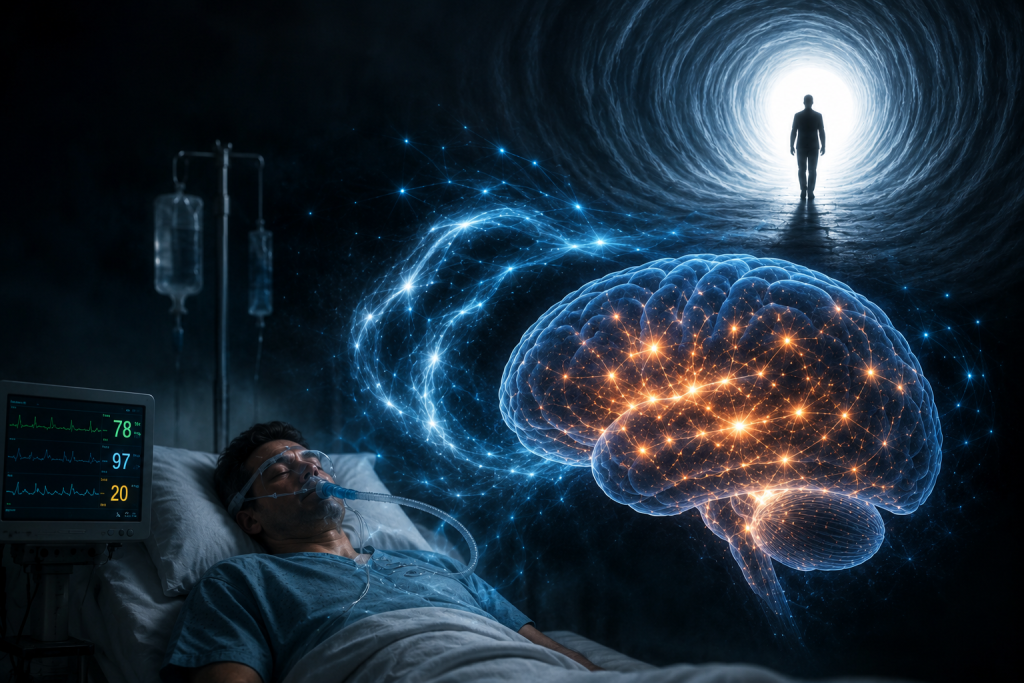
A growing body of research across 35 countries shows that roughly 10% of people report near-death experiences featuring strikingly consistent elements — and new research suggests the brain itself may be generating them.
Millions of people have come back from the edge of death with a story. New research suggests the brain itself may be writing it.
Nobody really knows what happens when you die. Religions have been built around the question. Scientists have spent careers trying to answer it. And yet, for all of human history, death has remained the ultimate unknown.
Until, that is, people started coming back.
About 10% of people across 35 countries report having had a near-death experience, according to a survey published in PeerJ, cited by Vice. That’s not a rounding error. That’s millions of people who came close enough to death to bring back a story — and here’s the part that stops you in your tracks: the stories are almost identical.
Leaving the body. Moving toward light. Reuniting with someone who died before them. An overwhelming, indescribable sense of peace. And then — coming back, often changed forever.
So what is actually happening? Science is starting to find out.
The Brain Doesn’t Just Switch Off
The first thing to understand, according to Popular Mechanics, is that dying isn’t like flipping a light switch. The brain doesn’t simply go dark. What actually happens is far stranger — and far more fascinating.
A 2023 University of Michigan study analysed EEG and ECG recordings from comatose patients whose ventilators had been withdrawn. In two of the patients, researchers observed something extraordinary: a dramatic surge in gamma brainwaves within seconds of cardiac decline.
Gamma waves are the brain’s highest-frequency output — associated with peak conscious processing, perception and awareness. These surges weren’t random noise either. They were synchronised with slower brain rhythms and showed strong connectivity across the brain, particularly in the “posterior hot zone” — an area linked to vision, bodily awareness and sensory processing.
“There was a highly organised surge across key regions of the brain — as if the entire system is momentarily lit up from within,” said Dr Jimo Borjigin of the University of Michigan.
She noted the activity also appeared in the temporoparietal junction — a brain region frequently associated with out-of-body experiences, which are among the most commonly reported elements of NDEs.
Why would the dying brain go out in a blaze of activity rather than a quiet fade? Borjigin offers a compelling theory: the brain may be launching a desperate internal search for survival — reaching deep into memory, hunting for unresolved purpose or a reason to keep going.
“We think of a comatose person as ‘gone,'” she said. “But even in those states, organised gamma activity appeared in regions tied to visual awareness. It’s a kind of twilight consciousness, possibly hidden but active.”
Your Life Shapes What You See
A March 2026 hypothesis paper published in Frontiers in Psychology, also highlighted by Popular Mechanics, takes the science even further — and into genuinely provocative territory.
Researcher Recai Kayış of Istanbul Aydın University proposed what he calls the dying-moment dream hypothesis. His argument: near-death experiences aren’t random hallucinations. They are a final, internally generated simulation — built entirely from the dying brain’s own stores of memory, emotion, cultural belief and deeply encoded symbolic material.
As oxygen supply collapses, external sensory input weakens. At the same time, internal systems related to memory, emotion and selfhood briefly become highly active — even disinhibited. The brain, cut off from the outside world, turns completely inward.
“Memory provides the content,” Kayış said. “Emotion gives that content force. Culture gives it symbolic shape.”
The result? A closed internal reality that feels more vivid, more meaningful and more real than ordinary waking life.
The theory’s most striking claim is this: the emotional tone of the experience — whether it feels peaceful or terrifying — is shaped by the life you lived. A life built on love, connection and purpose would, in theory, produce a very different ending than one defined by trauma, regret and unresolved guilt.
Cultural context plays into it as well. In Christian cultures, the bright light is perceived as a divine being or presence. In Japan, the same light is more often reported as an inanimate object. Same phenomenon, different symbolic dressing — drawn from the culture the dying person already carried inside them.
Mostly a Good Trip — But Not Always
The emotional picture emerging from NDE accounts is, for the most part, remarkably positive, per Vice.
Research from France and Belgium found that feelings of peace dominated the experience, with many people also reporting a sudden sense of understanding everything at once — a complete, momentary clarity about life, death and existence.
A large multi-site study of cardiac arrest survivors found patients reporting overwhelming peace and love during the period they were actively receiving CPR. People being brought back to life, experiencing what felt like the most profound peace of their existence.
About 14% of NDE accounts do include distressing elements — so it isn’t universally a beautiful experience. But the majority of people who report anything at all describe something they didn’t want to leave.
The Quantum Wildcard
For those who want to go even deeper, Popular Mechanics also explores quantum immortality — an offshoot of physicist Hugh Everett’s Many-Worlds interpretation, first proposed at Princeton in 1957.
The theory suggests that every quantum observation splits off a copy of the universe. By extension, quantum immortality proposes that when you die in this universe, your consciousness shifts to a parallel one where you survived. MIT physicist Max Tegmark investigated a related concept called quantum suicide as a thought experiment — though it remains exactly that, since parallel universes cannot currently be accessed or verified.
The Bottom Line
Fewer than 40% of people who come close to death report any conscious experience at all. There’s a very real possibility that for most people, death is simply nothing — no light, no peace, no reunion with anyone.
But for the millions who do come back with a story — consistent, vivid and life-altering — the experience tends to reshape everything about how they see the world, what they value and what they no longer fear.
The science isn’t settled. The mystery isn’t solved. But the more researchers look, the more they find that the dying brain is doing something extraordinary in its final moments.
Whether that means anything beyond biology remains, for now, the biggest open question in human history.
NEWS NOW: