
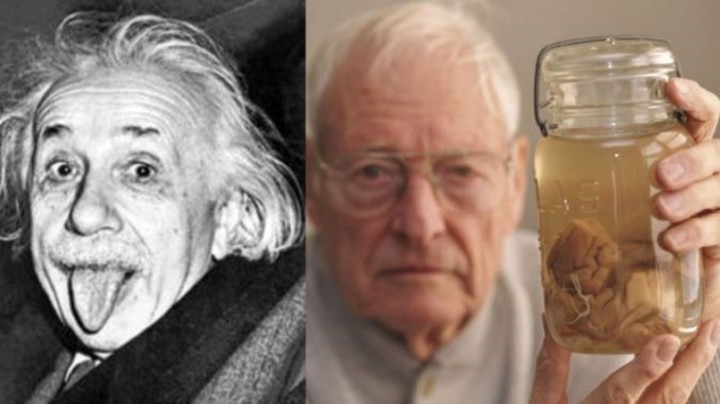
After Albert Einstein’s death in 1955, pathologist Thomas Harvey secretly removed his brain and kept it in storage for decades, eventually distributing samples in a Kraft Miracle Whip jar to scientists whose studies revealed little about what made his genius remarkable.
Albert Einstein requested cremation after his death on April 18, 1955, reportedly telling his family: “I want to be cremated so people don’t come worship at my bones.” But pathologist Thomas Harvey had other plans. During the autopsy, Harvey removed Einstein’s brain without permission—a violation that would spark decades of controversy.
For 45 years, Harvey preserved most of the brain in storage, dividing it into 240 blocks and creating tissue sample slides. When reporter Steven Levy investigated in 1978, the story finally emerged: Harvey had measured, weighed, and photographed the organ but published virtually nothing about his findings.
When neuroscientist Marian Diamond from UC Berkeley requested samples, Harvey mailed them in an unconventional container—a jar that had once held Kraft Miracle Whip mayonnaise. Diamond’s 1985 study found Einstein’s brain had a higher percentage of glial cells in areas associated with complex thinking, while a 1996 study noted more tightly packed neurons.
However, these findings proved inconclusive. As curator Anna Dhody explained: “There’s a night-and-day difference between a living brain and a dead brain.” Psychologist Terence Hines emphasized the flaw in drawing conclusions from a single specimen, comparing it to claiming he’d found the “centre of stamp-collecting” by examining one collector’s brain.
Harvey’s unauthorized removal cost him his job at Princeton Hospital. When asked why he took the brain, he simply stated: “I didn’t know anyone else wanted to take it.”
NEWS NOW: