
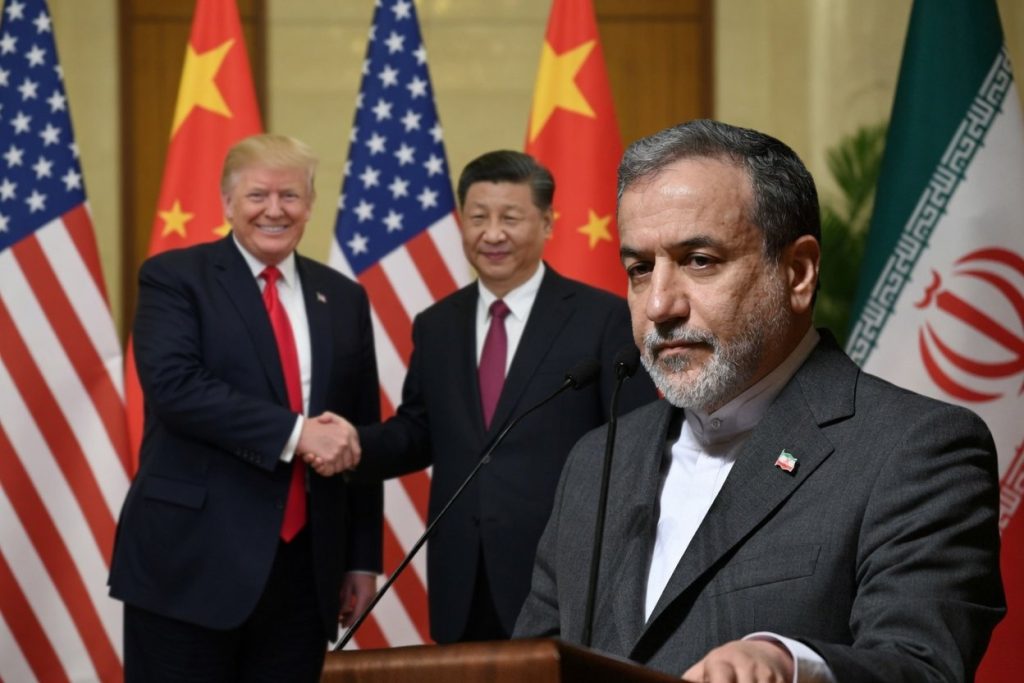
After Trump and Xi’s latest meeting, the Islamic Republic suddenly looks like a regime watching its last major lifeline slip away.
Right after reports came out that China and the U.S. agreed the Strait of Hormuz needed to stay open, Iranian Foreign Minister Abbas Araghchi rushed out and announced the Strait was now “completely open” again.
That is not confidence but a regime scrambling in panic as its leverage rapidly collapses.
The Islamic Republic spent years acting like China desperately needed Iran. In reality, the relationship was always massively one-sided.
U.S.-China trade is still worth over $400 billion annually even after years of tariffs, tensions, and economic rivalry. China-Iran trade is tiny by comparison, even when including shadow oil shipments and sanctions evasion.
Iran’s discounted oil is useful to China, but stable economic relations with the U.S. are vastly more important to Beijing.
That is the brutal reality Iran’s leadership seems to be crashing into right now.
Even the heavily publicized 25-year China-Iran agreement increasingly looks less like a strategic partnership and more like a dependency arrangement where the Islamic Republic became economically beholden to Beijing while receiving far less in return than originally advertised.
China gets heavily discounted oil, leverage, and access. Iran gets deeper dependence, sanctions exposure, shrinking alternatives, and an economy increasingly tied to Beijing’s calculations.
And when China has to choose between a $400+ billion relationship with the U.S. or a heavily sanctioned Iran selling discounted oil through shadow networks, the answer was always obvious.
For decades, the Islamic Republic relied on three big cards:
⚪️ Threatening Hormuz
⚪️ Selling cheap oil to China
⚪️ Using proxy militias and instability as leverage
Now all three are weakening at once.
The Islamic Republic increasingly looks like a regime that badly overestimated how important it actually was to China.
NEWS NOW: